Astrological undercurrents in the catholic church
The point of this writing is not to make an argument against Catholicism or Christianity. In fact, the deeper you go into the Western esoteric tradition, the more you understand why Christianity rejects divination, favoring a stringent spiritual hygiene, one specific god. Any spiritualist can tell you not all deities are for all people. Many people within the western world have ancestral exposure to the Christian God. Therefore, he is familiar with these souls. He is on their “spirit team," as Gordon White of Rune Soup would say, which suggests that he may play a supportive role in their spiritual journey, being connected to their ancestral beliefs, helping them navigate their faith and spiritual practices influenced by their heritage. While I could go into the subject of egregores here, I would like to keep this blog under 3000 words.
You cannot divorce spirit and matter without death. This principle also applies to both esoteric and exoteric concepts indefinitely. The West further echoes this idea by excluding the feminine from its religious systems, with the exception of the Catholic Church's veneration of Mary. I have my theories on how this trickles down into the psychological bifurcation of the “G-d” and “G-ddess” in the individual. We are unable to associate some of our actions and intent with outcomes around us and therefore within the wider world. The West further mirrors this idea by excluding the feminine from its religious systems, with the exception of the Catholic Church's veneration of Mary. In short, intuition and grace are not something we can strategically acquire on our own. In my experience, it’s a matter of faith at first, then coming into knowledge. At this stage, you can’t knowingly do bad things. You can’t follow crowds hoping that “it might work for me”. It’s actually a difficult position to be within the world. To a certain degree, the ability to predate and deceive is highly correlated with financial success. Most businesses would be out of business in a world filled with intuitive and ethical people if you really think about it.
The Catholic Church rejects astrology as divination. Nevertheless, the use of planets or stars to mark religious observances is undeniable and extends beyond mere astronomy. There is a distinct association between Christ’s life and celestial events. The difference between an astrologer and a Christian lies in their perspectives. An astrologer would be quick to point out the importance of said celestial events, while a Christian would see them in the context of Christ’s life. All that said, the Church still has a bit of a rumored esoteric-astrological-magical history. I can understand if not appreciate Catholicism's edicts around astrology, as all exoteric religion is, at least in my view, a form of spirituality meant to appeal to a wide variety of people. In a religious system, social cohesion is preferable, as the communal aspects of faith often provide support and connection that enhance individual spiritual journeys. There are several examples of why a traditional Catholic ethos would be in conflict with astrological culture as we know it today:
It has historically been a practice of the rich. Religion places value on living humbly despite having wealth. In the case of the Catholic Church, such an approach can seem a bit ironic, as the Vatican is quite wealthy. While many can access an astrological horoscope today, consulting an astrologer still costs more than a blue-collar budget would allow.
Personal astrology can lead individuals to feel superior to others via secret knowledge.
It can tempt you to place too much emphasis on the art of timing a life but not really attempting to grow in spiritual life by being present.
Despite all this, I believe that astrology was understood as a valuable undercurrent within the Catholic Church.
Church Stance
An earlier form of astrology, more like astronomy, de-mythologized astrology into a science of using planets and constellations to understand weather and other natural phenomena while rejecting its personal divinatory use. St. Augustine rejected astrology on a logical and religious basis; however, he did approve of astrology for weather forecasting (1), as did Spanish theologian and Archbishop Isadore of Seville. Both condemned the casting of horoscopes. While we may associate weather forecasting with actual astronomical and scientific methods, the use of astrology was still employed at this time to determine the likelihood of floods and drought. The Church also rejected pagan practices around star worship and planetary deities, which rivaled Christianity at that time. However, this use of astrology speaks faintly to its core and obvious truth: the Earth is influenced by the cosmos. The two sciences of astrology and astronomy wouldn’t separate formally until around the 17th and 18th centuries, when astronomy, still considered a serious science, grew organically away from astrology as we know it today. Perceived as a pseudoscience, it was incompatible with a verifiable scientific movement. Reductionist thinking typically denies holism, which is aligned with a more mystical, some might even say feminine, current of thinking spirituality, often contrasting with the empirical approaches of modern science.
Christian and Eastern Origins
12th-century Catholic Europe saw an astrological revival partially due to Catholic calculations for Easter. Isidore of Seville permitted what he called the study of natural astrology, the study of lunar and solar cycles, to calculate the holiday, which falls on the first full moon after the spring equinox. This calculation was called computus (2). This full moon had no zodiacal attribution typical of astrology today. Clearly, the focus was on Christ and not Libra or Venus. Being an astrologer, I would interject that Christ as a solar deity figure in opposition to a Libran moon is a ripe symbolism for trials and crucifixion. Computus would lead to a collaboration between Arabic and Western scholars that resulted in the translation of many Arabic astrological texts. Roger of Hereford was a computist who translated numerous Arabic astrological texts. He included divinatory and horoscopic astrology as part of a Catholic curriculum at Hereford, England. At this time, records state that students were more versed in Arabic texts than Latin, alluding to a possible organic inclination toward studying Arabic-sourced subjects such as mathematics, astrology, and astronomy over Latin theology. I don’t believe this shift was solely due to astrology being a wildly popular subject. Within England and Ireland, especially in what is called the “Celtic” church, Eastern influence had been, at one time, dominant over that of Rome. The Celtic Church imported Egypt’s monastic system as the dominant framework of ecclesiastical society. Mithraic altar stones have been found in Scotland, indicating that Mithraism, an eastern Iranian religion (also practiced by Romans), was practiced at some point on the British Isles before Roman Christianity flourished (3). Celtic monks, like those in Egypt, were at one time allowed to have wives and families. This practice is in contrast to celibate Roman Catholic monks. Lastly, the interior design and decor of Celtic churches show elements of Eastern design, such as wheel crosses and plaitwork motifs. There are also many examples of the zodiac being represented in cathedrals and synagogues. Celtic Catholicism is usually associated with a more mystical and feminine Mariological Catholicism. It is no coincidence, in my opinion, that the astrological revival in the West came from the East, which has placed importance on the natural and cosmological sciences.
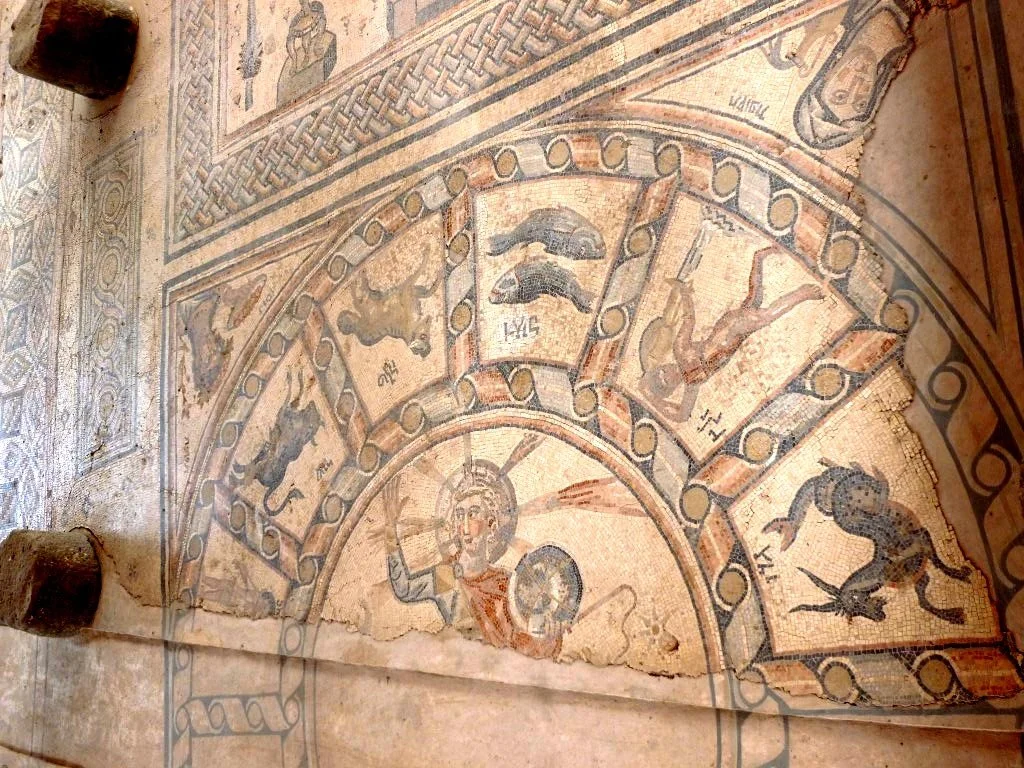
Mosaic floor in Hammat Tiberius Synagogue
The catholic Grimoire Tradition
Another, more openly magical reason why I feel astrology is an undercurrent within the Catholic Church is the grimoire tradition and its astrological associations with demons, but especially angels. The names of the 7 archangels are said to have come into Jewish teaching during Babylonian captivity and integrated the knowledge of various other religious groups, such as Zoroastrians (4). In short, these archangels were associated with constellations and planets within those non-Judaic systems. It is known and documented but not widely acknowledged except among new age cat moms such as myself. I’ve seen more than a few angel tarots in my time.
During the Middle Ages, many grimoires were written that incorporated advanced knowledge of scripture and Latin. The profile of said authors would have been that of highly educated theologians, if not actual priests within the Catholic Church. In the Middle Ages, most people were illiterate and could not read Latin. Those of you familiar with ceremonial magic understand it goes way beyond what you see in your average Instagram magic ritual reel. The money required for completion of said rituals would only have been available to royalty, aristocracy, or priest classes. You and I can buy candles at Walmart or the local botanica down the street. Most of my readers, I’m willing to bet, cannot buy pure gold, rare incense, and lionskin belts with magical symbols written on them at the drop of a hat. I honestly cannot think of a desire that would motivate the coordination of such a ritual.
Helena Blavatsky outlines a story that aligns with said astrological angel magic theory. In her essay Star-Angel-Worship in the Roman Catholic Church, she writes:
“Again the famous Father Gastaldi (also known as Thomas Castaldus), the Dominican monk, writer and Inquisitor, had proven in his curious work "On the Angels" (De Angelis) that the worship of the "Seven Spirits" by the Church had been and was legal in all the ages; and that it was necessary for the moral support and faith of the children of the (Roman) Church. In short that he who should neglect these gods was as bad as any "heathen" who did not.” (5)
For those of you more familiar with theosophy and even academic research on Enochian Jewish cults, it’s almost as if certain priests and reformers inserted angels as gods to be worshiped in the place of a higher, more abstract god who was simply not creative or destructive, lying outside of duality. The West wasn’t ready for what seems to me like a form of Christian philosophy that was more like Buddhism than what Christianity is today. The creator god, in very Gnostic terms, has power to create. There is almost an economic-spiritual benefit to worshiping a god that “manifests”. The Catholic god is this creator god.
Outro and unsolicited opinion
It was hard to overlook the recent Zionist vs. Catholic Christian kerfuffle in the context of recent events. I am beginning to believe that what was thought to be Jewish or Semitic elements within Christianity may have been taken from an older Middle Eastern belief system that Gnostics (Jewish and Christian) were trying to preserve. This belief system bears a resemblance to Zoroastrianism or even Druidism and would have taken astrology into its theology. This does not necessarily refer to personal horoscopes but to the mythopoetic concepts of the zodiac. Both Gnostics and Druids appear to be staunchly anti-institutionalists in terms of spirituality. The Druids famously refused to write down any of their teachings because they believed that Rome would either destroy or rewrite them. The mainstream line on all Western cults, especially those that incorporated a goddess, is that there was much mischief afoot. The talk of Baal worship is enough to make one's head spin nowadays, and it’s true, some of these earlier cults were not all innocence and light. The darker aspect of the human psyche has at one time or another embraced human and animal sacrifice; however, there is evidence of other pre-Christian cults that firmly rejected it, such as those that focused on fertility and agricultural rites, which emphasized life and renewal instead of death. Christianity has spiritualized concepts of sacrifice that are both physical (in the case of Jesus) and spiritual. I have to agree with Philo that the worship of stars is astral worship (6). The planets and stars are intelligences; they have no independent will but serve a higher force that is completely outside the control of them. In this train of thought, a true astrotheology probably wouldn’t require worship or liturgies. It could never be compatible with Catholicism. It would present a picture of the universe and provide context for ordering affairs on earth, including our psychological landscapes. However, I digress. Creating any system of veneration would eventually lead to worship, and it might even revert to the ancient tendency to prioritize physical sacrifices over wisdom, understanding, and Sophia. I will stick to my vision of Christ as a symbol for the spiritual sun, in that he transcends the planets and the earthly gods while acknowledging their place within the natural order.
Sources:
O’Rourke, B., & Laird, M. S. (2013). Confessions: St. Augustine. Darton, Longman and Todd.
Computus solaris et lunaris, produced in Italy during the 1390s with an Easter chart to the year 1882.
Churchservicesociety. (n.d.). https://www.churchservicesociety.org/sites/default/files/journals/1930-1931-9-15.pdf
ANGELOLOGY - JewishEncyclopedia.com. (n.d.). https://jewishencyclopedia.com/articles/1521-angelology#anchor16
Blavatsky, H. P. (1917). Star-Angel-Worship in the Roman Catholic Church.
Taylor, J. (2025). Astrology in Philo of Alexandria’s de vita contemplativa. Kcl. https://www.academia.edu/446178/Astrology_in_Philo_of_Alexandrias_De_Vita_Contemplativa